The school day ends. You get home. You sit down for a moment — and immediately think of the three things you did not finish today.
The copies not checked. The parent you meant to call back. The lesson plan for tomorrow that still needs work.
You are tired. But it is not the kind of tired that sleep fixes.
You wake up the next morning and it is still there.
If that sounds familiar, you are not alone. And more importantly — it is not because you are not trying hard enough.
It is not because teaching is too demanding. It is because nobody told you what kind of game you are actually playing.
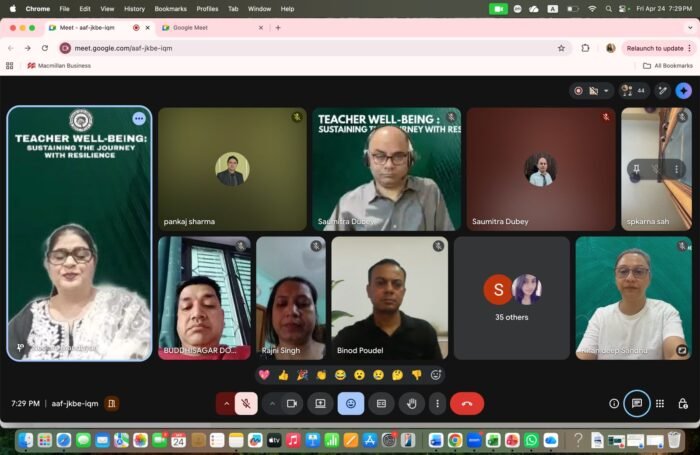
That was the starting point of a session GBTC Trust hosted last month. Around 100 educators joined — teachers, school coordinators, and education professionals from across India and Nepal. The session was led by Saumitra Dubey, Resilience Coach and Project Director at GBTC Trust. What he said that evening is worth sharing with every teacher who has ever felt this way.
The Real Cause of Teacher Burnout
Ask most people why teachers burn out and they will say: too much work, too many students, not enough support. These are real. Nobody is dismissing them.
But Saumitra pointed to something deeper. He drew on an idea from Simon Sinek’s book The Infinite Game — and applied it directly to teaching.
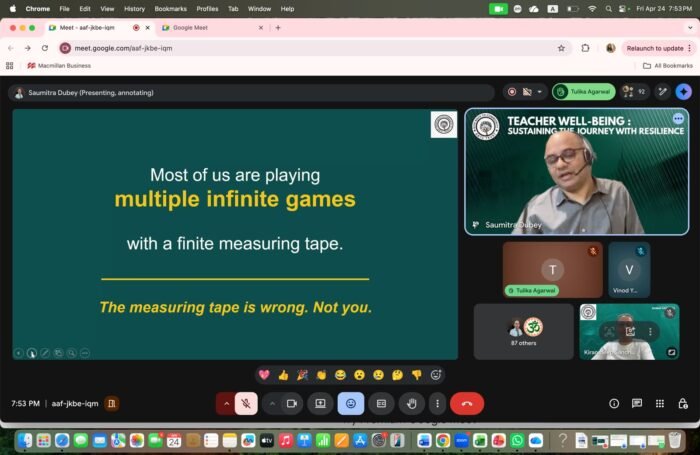
Sinek describes two kinds of games. A finite game has a clear end point — a match, an exam, a project. You play, it finishes, there is a result. An infinite game has no end point. The goal is not to win. The goal is to keep playing, to keep improving, to outlast the obstacles.
“Teaching is an infinite game. There is no finish line. Results come in March — and in April, a new batch walks in. Same syllabus. New faces. Start again. The work was never designed to end.”
The problem, Saumitra said, is not the infinite game. The problem is that most teachers are playing it with finite thinking.
We wait to feel done. We measure our worth by results that reset every year. We look for a finish line that does not exist. And when we do not reach it — when the list resets again tomorrow morning — we feel like we have failed.
That feeling — not the workload — is what causes burnout. The exhaustion comes from the mismatch between the game and the thinking. Change the thinking, and the same work feels different.
Does This Sound Familiar?
Here are two situations. Read them and see if either rings true.
1. The list that never ends
You finish school, get home, and the work follows you. Copies to check. Lessons to plan. Messages to reply to. You sleep, you wake up, and a new list has already started. There is no moment in the day — not really — where you can say: I am done. The task list was not designed to finish. But you keep treating it like it should.
2. School ends at 3. But you don’t.
You leave school and walk into a second shift — family, home, responsibilities that are also infinite. Two jobs, neither of which ever truly finishes. And somewhere in the middle of all of it, you are supposed to also be okay. You are not a machine. But the day is structured as if you are.
Both of these are examples of finite thinking applied to an infinite game. You are treating things that were never meant to finish as if they should — and then measuring yourself against that impossible standard. The measuring tape is wrong. Not you.
The Shift: From Finishing to Running Your Leg Well
So what changes? Not the workload. Not the hours. The thinking.
Saumitra used the image of a relay race. In a relay, no single runner is supposed to run the whole race. Someone before you picked up the baton and ran their leg. They handed it to you. You run yours. Then you pass it forward.
Education works the same way. A child comes to you carrying everything the teachers before you gave them. You add to that. You pass them forward. You will never see the end of that child’s journey — and you were never supposed to. Your job is to run your leg well and hand the baton on.
“The shift is not from working less to working more. It is from asking ‘when will I finish?’ to asking ‘am I running my leg well today?’ That one change — in how you measure a day — is what separates the tiredness that breaks you from the tiredness that prepares you for tomorrow.” [cite: 46]
NEP 2020 speaks directly to this. It recognises that teacher wellbeing is not a nice-to-have sitting on the side of education reform. It sits at the centre. A teacher running on empty cannot give students what they need. Matching your thinking to the game you are playing is not just personally useful — it is what sustainable teaching requires.
One Question for Tomorrow Morning
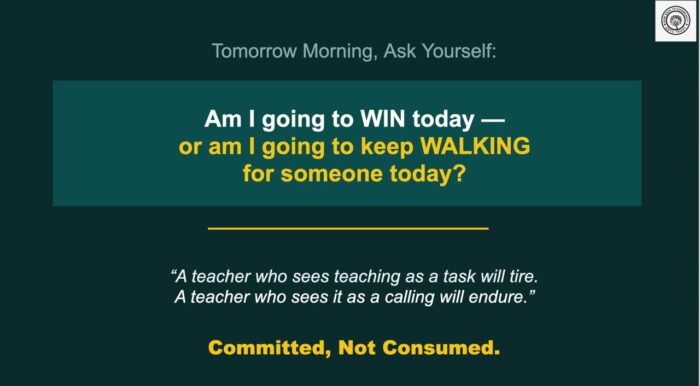
Saumitra ended the session with something simple. Not a habit tracker. Not a five-step plan. Just one question — to ask yourself before you leave for school each day:
“Am I going to WIN today, or am I going to WALK for someone today?”
If your answer is about results and tasks: That is finite thinking. The tiredness at the end of today will leave you empty.
If your answer has a child in it: A face, a classroom, something you want to contribute to — that is infinite thinking. You will still be tired, but it will prepare you for tomorrow rather than taking from it.
The Man Who Lives This
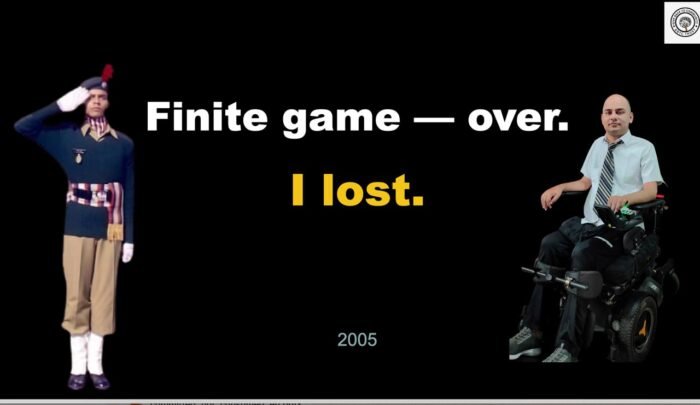
Saumitra Dubey wanted to be a soldier. A bike accident ended that, leaving him quadriplegic and dependent on others for his basic needs. He operates his laptop by voice, using a small amount of movement in his right hand to steer his motorized wheelchair.
Instead of stopping there, he built something incredible. He teaches and counsels young prisoners at District Jail, Ayodhya. He runs Project Super 60 supporting 62 underserved students, manages 30 mentors, and works with over 100 teachers through the GBTC Smart Class project to bring technology into classrooms.
“When 100 teachers heard him speak about burnout, they were not hearing theory. They were hearing someone who has no option but to play the infinite game. As someone wrote in the chat: ‘He lives what he teaches. That itself is the lesson.'”
Three Things to Try This Week
Ask yourself the morning question genuinely: Before you leave for school, ask: am I here to win today, or to walk for someone? Just notice what your honest answer is.
Evaluate your evening: When you sit down tonight, ask yourself: did I run my leg well today? Not if you finished everything, but simply if you ran your leg well. That is the only scoreboard that matters.
Let go of the unfinished list: The next time the list does not finish, remind yourself that it was never supposed to. You are not behind. You are in an infinite game.
Committed — not consumed. That is the difference.
Join GBTC Trust’s Monthly Professional Development Sessions
Every last Friday of the month | 5:00–6:00 PM IST | Free and open to all educators
Join the GBTC Growth Hub WhatsApp group to stay updated on upcoming sessions.
The Infinite Game by Simon Sinek — practical, accessible application to leadership and everyday life.
Finite and Infinite Games by James P. Carse — the original, philosophical text. Worth reading slowly.
About the Author:
Kiran Deep Sandhu is the Founder of GBTC Trust (Give Back to Community Trust), a non-profit working in teacher empowerment, educational equity, and leadership development across India and Nepal.
About the Speaker:
Saumitra Dubey is a teacher, TEDx speaker, and resilience coach. As Project Director of GBTC Trust, he leads volunteer teams across Uttar Pradesh and manages impactful community initiatives like Project Super 60 and GBTC Smart Class.