From Disruption to Participation: Engaging Every Learner

Why the students who speak the loudest—and those who rarely speak—both deserve our attention.
By Kiran Deep Sandhu | Founder, GBTC Trust | November 2026
I wasn’t the shy student sitting quietly at the back of the classroom. I was the one who interrupted lessons, challenged instructions and regularly tested my teachers’ patience.
At Modern Indian School in Kathmandu, my mathematics teacher, Mr. Jha, had more than his share of trouble with me. My father had founded the school, but that was no excuse for my behaviour. I was restless, outspoken and not always sure how to channel my energy.
Years later, as an educator and Founder of GBTC Trust, I still ask myself: What might have helped turn that energy into meaningful participation? I cannot rewrite my school years, but they have shaped how I think about children who are quick to speak—and those who hardly speak at all.
“A noisy student is visible. A quiet student may be overlooked. Neither tells us who is actually learning.”
Participation Is Not the Same as Learning
In a classroom of 45 students, a teacher may ask, “Is everyone clear?” A few hands go up. Others nod. Some stay silent. But a nod is not proof of understanding, just as an interruption is not proof of disinterest.
Teachers need ways to look beyond the most visible responses. The challenge is to make space for more children to think, show what they understand and receive the support they need—without turning every lesson into a complicated exercise.
[Image placeholder 2: Insert
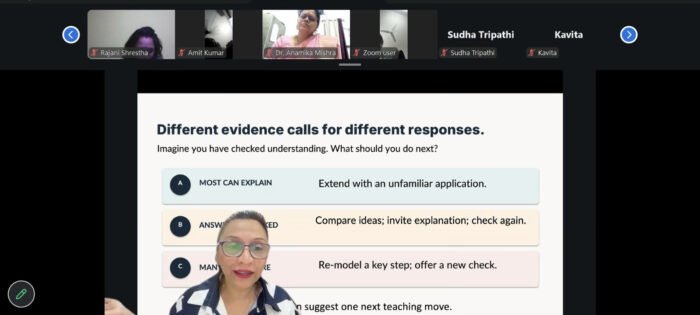
image 2 here]
Engage, Check, Respond: A Simple Teaching Habit
One practical approach explored in GBTC Trust’s Professional Development Session was a three-step routine that can work across subjects and age groups:
1. Engage — Who gets to think?
Give every learner a moment to consider a question before calling on volunteers. A brief written response or partner conversation helps more students enter the discussion.
2. Check — What did they understand?
Ask for a quick response from the whole class, not only the usual hand-raisers. Students might show an answer on paper, a slate or with a discreet finger vote.
3. Respond — What should I do next?
Use the answers to guide the next step. If many students are unsure, explain the idea differently. If responses vary, let students compare their reasoning. If understanding is strong, offer a new challenge.
The important part is the third step: checking understanding only becomes useful when it changes what the teacher does next.
Three Classroom Strategies Worth Trying
Give everyone thinking time
Before inviting answers, pause for 30–60 seconds. Let students jot down an idea and discuss it with a partner. This gives hesitant learners time to prepare and reminds confident speakers that listening matters too.
Ask everyone to answer at once
Pose a question with two or three possible answers. Have students choose privately, then reveal their choices together. The teacher can scan the room, notice patterns and decide whether to clarify, discuss or move forward. A quick vote is a starting point for understanding, not proof that everyone has mastered the topic.
Give energetic students a useful role
When a child frequently calls out, set a clear turn-taking expectation and offer a role such as questioner, summariser or discussion timekeeper. The goal is not to reward disruption, but to channel participation while making room for other voices.
These are options, not rigid rules. Teachers can adapt them to class size, students’ ages and the time available.
Beyond the Classroom: What Should Education Leaders Consider?
India’s National Education Policy 2020 emphasises more experiential and inquiry-based learning. Yet teachers need practical support to translate these principles into a crowded, everyday classroom.
School leaders can create space for teachers to try short participation routines, discuss what they notice and adapt their practice. Teacher-training programmes can demonstrate these routines instead of only describing them. For policymakers, the question is equally practical: Are we equipping teachers to notice what students understand and respond during the lesson itself?
When professional development connects ideas to classroom decisions, it becomes more useful to teachers—and more relevant to learners.
One Idea to Try Tomorrow
Ask a question that every student can answer in a word, a sentence or a choice. Before inviting anyone to speak, let everyone write a response. Look at the answers, then decide: Should I explain again, invite a partner discussion or move to the next challenge?
It is a small shift from asking “Who knows?” to asking “What are my students showing me?”
Continuing the Conversation
I do not know exactly what would have helped my younger self in Mr. Jha’s classroom. But I know that the loudest student and the quietest student both deserve to be understood beyond their behaviour.
Educators, what helps you engage a child who often interrupts without overlooking the child who rarely speaks?
Share your experience in the comments. Your approach may give another educator an idea worth trying.
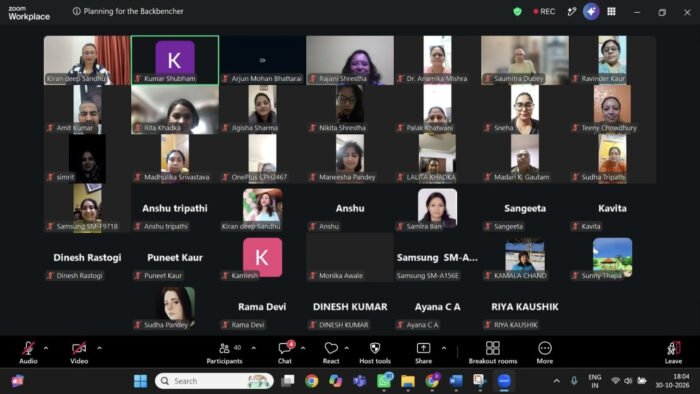
At GBTC Trust, our free monthly Professional Development Sessions bring educators together to explore practical approaches to teaching and learning. Join our Educator Network to continue the conversation.
Watch on You Tube Planning for the Backbencher: NEP 2020 Active Learning Workshop | Kiran Deep Sandhu: https://youtu.be/zlfvTx9ArrI?si=S70LcpMbmu-dk9Jt
Join the GBTC Educator Network: WhatsApp Community
www.gbtctrust.org | admin@gbtctrust.org

About the Speaker: Kiran Deep Sandhu
Kiran Deep Sandhu is an educator, TEDx speaker, John Maxwell Certified Leadership Coach, and Founder of GBTC Trust. With over 20 years of experience in education, communication, and leadership development, she is passionate about creating inclusive learning environments and empowering educators. Through GBTC Trust, she works to bridge educational gaps and expand learning opportunities for children in rural India. Email: kirandeep.sandhu@gbtctrust.org
#StudentEngagement #ClassroomManagement #ActiveLearning #TeacherProfessionalDevelopment #InclusiveEducation #KiranDeepSandhu