Active Learning in Rural Primary Schools: 4 Simple Changes
GBTC Trust Professional Development session led by Mr Dinesh Rastogi • Written By Kiran Deep Sandhu, Founder, GBTC Trust
What if some of the most meaningful changes in a classroom don’t require expensive technology, new furniture or additional resources?
Sometimes, they begin with how a teacher uses the classroom space, responds to a child’s mistake or creates opportunities for children to explore rather than simply memorise.
But how often do we question these everyday practices?
During a recent GBTC Trust Professional Development session, Mr. Dinesh Kumar Rastogi, a primary education practitioner with 28 years of experience in pedagogy and teacher training, invited educators to rethink what makes a classroom truly active.
His message was simple: children need opportunities to experience, explore, question and make mistakes as they learn.
The discussion offered four practical ideas that are particularly relevant to primary schools in rural India, where resources can be limited but the need for engaging learning experiences is just as important.
1. Before Children Memorise, Let Them Experience
Imagine teaching division to a young child.
You could write 6 ÷ 2 = 3 on the blackboard and ask the child to repeat it.
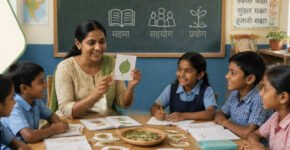
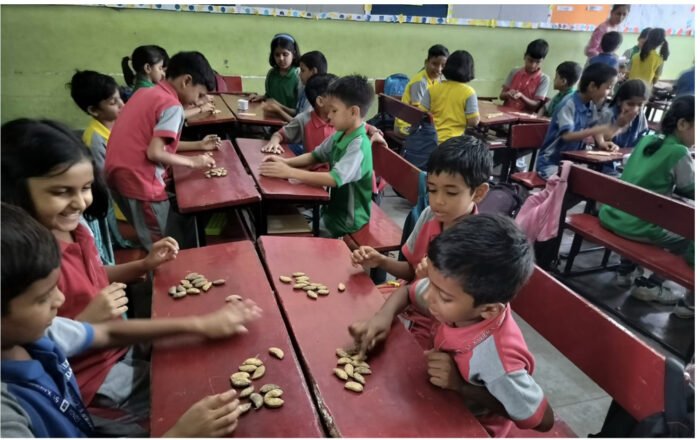
Or you could give the child six seeds and ask them to share the seeds equally between two friends.
Both approaches introduce the same mathematical concept. But the second gives the child an opportunity to discover what equal sharing actually means.
This is the thinking behind the ELPS approach: Experience, Language, Pictures and Symbols, highlighted by Mr. Rastogi during the session.
Children begin by experiencing a concept, talking about it, representing it through pictures and gradually connecting it to numbers or symbols.
For teachers, this does not mean abandoning textbooks. It means recognising that understanding can begin long before a child opens one.
In rural classrooms, locally available objects such as stones, seeds, sticks and bottle caps can become effective learning materials.
The question worth asking is: Are we teaching children to remember the answer, or helping them understand how to arrive at it?
2. A Classroom Should Be a Space for Learning, Not Just Sitting
We often discuss what teachers should teach and how they should teach it. But how often do we consider whether the classroom itself supports learning?
Mr. Rastogi drew attention to something as ordinary as a school desk.
Traditional slanted desks may work well for reading and writing, but they can make hands-on activities difficult. Seeds, counting objects and other loose materials may keep rolling off the surface.
A simple design feature can influence how easily children participate in an activity.
Does every school need to replace its furniture? Not necessarily.
Even small adaptations can make a difference. Teachers could use flat boards or trays for activities, rearrange desks for group learning or designate a small area for books and learning materials.
Classroom walls also have untapped potential. An interactive calendar, number chart or map can become part of a daily learning activity rather than remaining a decoration.
An active classroom is not necessarily a classroom filled with expensive teaching aids. It is one where the available space and materials encourage children to participate.
3. What Changes When Teachers Move Around the Classroom?
Picture a classroom where the teacher explains a lesson from the blackboard while students sit in rows.
Now imagine the same teacher moving between desks, observing children’s work, listening to their explanations and noticing who needs support.
This is the idea behind Teaching While Walking Around (TWWA), a practice emphasised during the session.
The value is not simply in moving around. It lies in what teachers can discover when they pay closer attention.
A child who remains silent may need encouragement. Another may be struggling with a concept but hesitant to ask for help. A third may have found an interesting solution worth sharing.
These moments are easier to recognise when teachers observe learning as it happens.
Mr. Rastogi also emphasised the importance of respecting children’s home languages and local dialects.
In multilingual classrooms, allowing children to express ideas in a language they are comfortable with can help them participate more confidently while they develop proficiency in the language of instruction.
Good classroom management is not only about maintaining discipline. It is also about noticing, listening and responding to learners.
4. What If We Stopped Hiding Mistakes?
This was perhaps one of the most thought-provoking ideas from the session.
Mr. Rastogi encouraged educators to reconsider the routine use of erasers in primary classrooms.
Think about what happens when a child writes an incorrect answer and immediately erases it.
The mistake disappears. But so does an opportunity to understand how the child was thinking.
One practice suggested during the session was to encourage children, particularly from Class 2 onwards, to draw a single line through an incorrect answer and write the correction beside it.
The original answer remains visible, allowing both the teacher and the child to revisit the reasoning behind it.
This is not simply about whether children should use an eraser. It raises a more important question:
Are we creating classrooms where children feel comfortable making mistakes, or classrooms where they are more concerned about getting everything right?
When teachers respond to mistakes with curiosity instead of immediate criticism, errors can become valuable opportunities for discussion and learning.
Beyond the Classroom: What Does This Mean for Education Leaders?
These four ideas are relatively simple. Yet implementing them consistently requires more than the efforts of individual teachers.
Teachers need opportunities to explore new approaches, practise them and reflect on what works in their classrooms.
School leaders can support this by encouraging flexible classroom arrangements, making space for practical activities and allowing teachers to learn from one another.
For teacher-training institutions and education policymakers, there is a broader question to consider.
Are professional development programmes giving teachers practical strategies they can use in the classrooms they actually teach in?
This matters especially in rural education, where teachers may need to adapt teaching methods to limited space, varied learning levels and locally available resources.
Improving education requires investment in infrastructure and learning materials. But it also requires continued investment in how teachers teach and how children learn.
These priorities should complement one another.
One Idea to Try This Month
The next time a child gives an incorrect answer, resist the urge to correct it immediately.
Instead, ask:
“Can you show me how you arrived at this answer?”
Give the child an opportunity to explain, reconsider and try again.
It is a small change in how a teacher responds, but it can open up a valuable learning conversation.
And sometimes, that is where deeper understanding begins.
Continuing the Conversation with GBTC Trust
At GBTC Trust, we believe that empowering rural education also means creating opportunities for teachers to continue learning, questioning and growing professionally.
Through our free monthly Professional Development Sessions, we bring together experienced educators and practitioners to share knowledge and explore teaching approaches that can be adapted to different classroom settings.
We thank Mr. Dinesh Kumar Rastogi for sharing his experience and encouraging educators to reconsider familiar classroom practices.
As we continue these conversations, we would love to hear from you.
What is one classroom practice you believe we need to rethink to help children learn better?
Whether you are a teacher, school leader, teacher educator or education policymaker, share your perspective in the comments. Your experience may offer another educator a fresh way of looking at their classroom.
Be part of the GBTC Educator Network.
Join our free monthly Professional Development Sessions and connect with educators who believe that learning never stops.
Join the GBTC Educator WhatsApp Community

GBTC Trust | Bridging the Gap Through Education
Website: www.gbtctrust.org
Email: admin@gbtctrust.org
Session YouTube: https://www.youtube.com/watch?v=QQHKop0TqFA&t=3488s
About the Speaker
Mr. Dinesh Kumar Rastogi completed his B.Tech in Electronics Engineering from the University of Waterloo, Canada (1970), and spent 26 years in the corporate sector before devoting the last 28 years to primary pedagogy, ECCE curriculum development, and teacher training. He has authored training manuals for UNICEF and the World Bank and trained educators across multiple Indian states.
About the Author:
Kiran Deep Sandhu is the Founder of GBTC Trust (Give Back to Community Trust), a non-profit working in teacher empowerment, educational equity, and leadership development across India and Nepal. email: kirandeep.sandhu@gbtctrust.org
#RuralEducation #ExperientialLearning #TeacherProfessionalDevelopment #PrimaryEducation #ActiveLearning #KiranDeepSandhu #GBTCTrust