GBTC TRUST | TEACHER PDP SERIES
When a Child Goes Quiet: A POCSO Guide for Teachers and Parents
Notes from a GBTC Trust Professional Development session led by Dr. Anamika Mishra • Written By Kiran Deep Sandhu, Founder, GBTC Trust
A ten-year-old stops raising her hand in class. Her marks haven't slipped enough to trigger a meeting with her parents — she's simply quieter than she used to be, a little more distant at pickup time. No one flags it. Her teacher does. And that single act of noticing is very often the only thing standing between a child in danger and a child who never finds the words to say so.
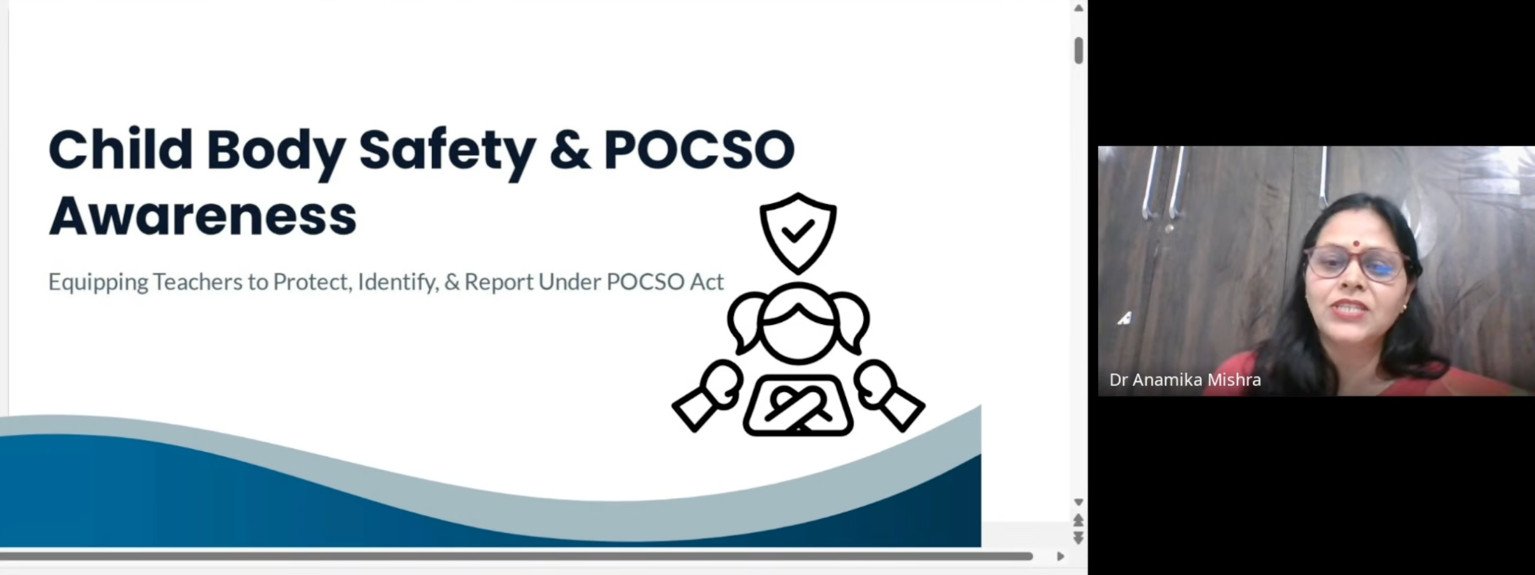
That’s the space GBTC Trust’s latest Professional Development session sat in. Close to 100 educators from across India and Nepal joined a session on child body safety and POCSO awareness, led by Dr. Anamika Mishra. What follows draws on that session, along with wider reading on how body-safety education actually works in practice, for teachers first, and for the parents raising the same children at home.
Why a Child Is More Likely to Tell a Teacher Than a Parent
Ask any child protection expert who a child confides in first, and the answer often surprises people: not a parent, but a teacher. Dr. Mishra unpacked why this holds true across almost every classroom in the country — and why it doesn’t mean parents matter less. It means the adults closest to a child, whoever they are, need the same instincts.
- Teachers see the child every single day. Six to eight hours, five days a week, is enough time to notice a change that even an attentive parent — caught up in a different routine — might miss for months.
- Trust is often built before home is told. A child will frequently test the waters with a teacher first, gauging how it feels to be believed, before deciding whether to say anything at home at all.
- Early notice stops harm from compounding. A concern raised in week one looks nothing like the same concern left to sit, unaddressed, for a year.
- A judgment-free response removes the biggest barrier to disclosure: the fear of being blamed, disbelieved, or punished for speaking up.
This is precisely why India’s National Education Policy (NEP 2020) doesn’t treat child protection training as optional for teachers. It builds the requirement directly into the system — mandatory POCSO training for staff, dedicated counselors placed in school complexes, background verification for every employee, and a rule that every school visibly display the Childline number alongside a POCSO e-Box for confidential reporting.
What the Data Actually Shows
Dr. Mishra opened the session with data, and for good reason — most of us carry a comforting myth about child sexual abuse: that it’s committed by strangers, in unfamiliar places. The numbers tell a different story. In the overwhelming majority of reported cases, the person responsible is someone the child already knows well — a relative, a neighbour, a family friend. Most victims fall between the ages of 12 and 18. And underneath all of it sits the figure that should give every adult in a child’s life pause: a large majority of cases are believed to go unreported altogether.
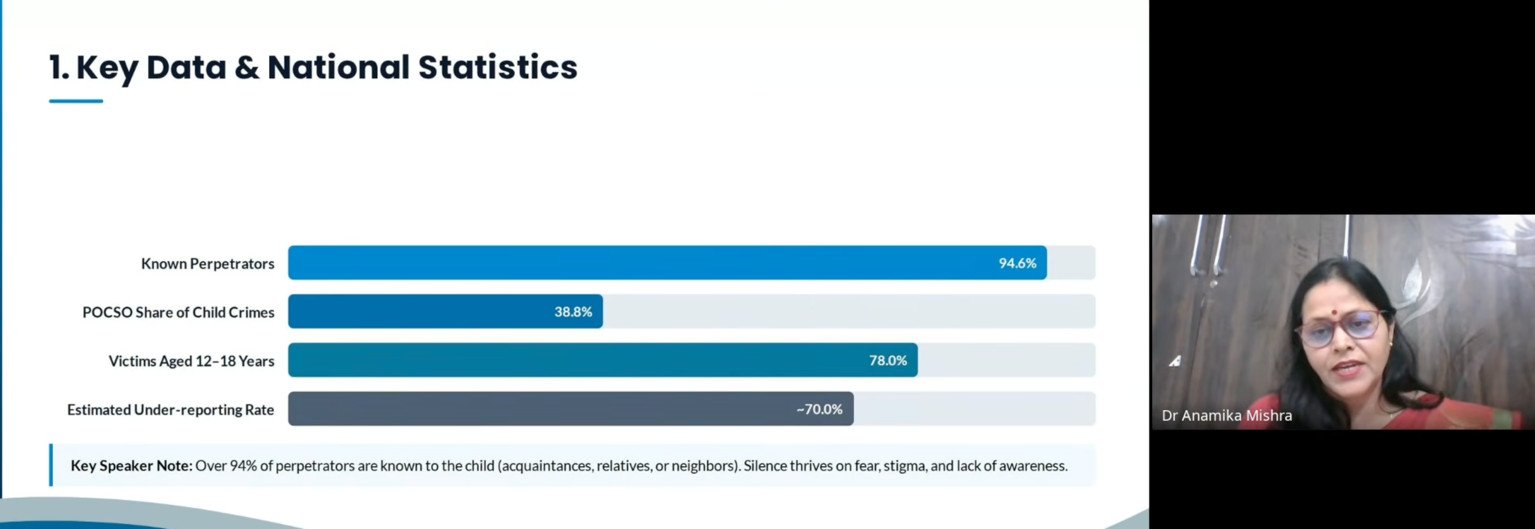
Silence isn’t safety. It’s almost always fear, shame, or a child who simply doesn’t yet have the words. Closing that gap between what a child is experiencing and what they’re able to say out loud is exactly where a watchful adult — teacher or parent — makes the difference.
Teaching Body Safety in Words a Six-Year-Old Can Actually Use
Talking to young children about their bodies runs into an old, familiar discomfort — most adults were never taught this themselves, and improvise badly when it matters. Effective body-safety curricula, wherever they’re drawn from, tend to converge on the same few techniques, and they translate just as well to a dinner-table conversation as to a classroom:
- Repetition, not a one-off talk. A short, repeated promise — that a child will raise their voice and not hide things from people they trust, builds the muscle memory to actually speak up when it counts, the same way a fire drill works because it’s practiced, not because it’s understood once.
- Rules for private parts, taught without contact. The most careful programmes explain this only through a diagram, never by touching or pointing at a child’s own body or the adult’s. The lesson is in the words, not the demonstration.
- A “circle of trust” exercise. Children draw or name the adults, at home and at school, they’d go to without fear. It’s a simple exercise, and it quietly gives a teacher or parent a clearer picture of who a child actually feels safe with.
- The difference between safe and unsafe secrets. A birthday surprise is a safe secret — it makes people happy and ends on its own. A secret tied to fear, a threat, or a gift meant to buy silence is unsafe, and the rule for children is unambiguous: it always gets told to a trusted adult.
- A story, not a lecture. Children absorb a short narrative about another child navigating this far better than a list of rules. The story that works models the exact response Dr. Mishra asked adults to bring to a real disclosure: believe immediately, say clearly it isn’t the child’s fault, and act without making a scene of it.
What Shows Up When a Child Can’t Say It Outright
Not every child will say the words out loud. Dr. Mishra walked the room through what often surfaces instead of a direct disclosure:
- Sudden behavioural change — withdrawal, unprovoked aggression, or unusual clinginess
- A sharp, unexplained drop in academic focus, alongside frequent stomach aches, headaches, or absences
- Regressive behaviour in older children — bedwetting, thumb-sucking, disturbed sleep, nightmares
- Knowledge or language about sex that doesn’t match the child’s age or development
None of these, on its own, proves anything. A pattern across several of them, sustained over time, is what deserves a closer look — from a teacher in the classroom, and equally from a parent at home.
What the Law Requires — and What It Protects You From
This is the part of the session that tends to surprise teachers most: reporting suspected abuse isn't a judgment call left up to individual discretion. Under Section 19 of the POCSO Act, any person — including teachers, counselors, and school staff, who knows or reasonably suspects abuse is legally required to report it without delay. Supreme Court guidance is explicit that a school cannot conduct its own internal inquiry first and decide afterward whether to involve the police. Failing to report, or deliberately delaying, is a non-bailable offense under Section 21 of the Act, carrying a fine or up to a year in prison.
The protocol Dr. Mishra shared with teachers was kept deliberately simple, so it holds up under pressure:
- Receive and listen — calmly, without shock or visible doubt, reassuring the child they’re safe.
- Document the facts — the child’s own words, the date, the time, what you observed, without leading or probing questions.
- Report immediately — to the Special Juvenile Police Unit, local police, or the National Childline helpline on 1098.
- Know you’re protected — Section 19(7) grants full immunity from civil or criminal liability to anyone reporting in good faith.
That last point matters more than it might seem. Most hesitation among teachers doesn’t come from indifference, it comes from fear of getting it wrong. The law is written specifically to remove that fear. Parents carry the same duty and the same protection, and the same helpline — 1098 — applies whether the child in question is a student or your own.
If You’re Reading This as a Parent
Everything above translates directly to a home. A few starting points that don’t require a curriculum:
- Use anatomically correct names for body parts, without embarrassment — vague language is exactly what makes it hard for a child to describe what happened to them, later, if they ever need to.
- Let your child say no to physical affection, even with relatives, even when it’s awkward at a family gathering. A child who’s allowed to decline a hug has an easier time refusing something that actually matters.
- Ask about secrets specifically, not just “how was your day.” “Has anyone asked you to keep a secret from me?” is a question most children have never been asked, and it opens a door.
- Believe first, investigate after. A child’s disclosure is rarely fabricated — treat it as credible from the first sentence, not after cross-examination.
Where to Start
- Use the correct words, at least once this week. Whether in a classroom or at home, vague language protects silence, not children.
- Know your reporting chain before you need it. A counselor’s name, the Childline number, your nearest SJPU — for a teacher, or a parent — is not information to be searching for in the middle of a crisis.
- Watch for the pattern, not just the incident. A child seeming a little more withdrawn or absent than usual is worth noting, not filing away.
Every child deserves a home and a classroom where they feel safe enough to speak. Neither teachers nor parents are bystanders in that story — between the two, they are almost always the first line of it.
Continue the Conversation
GBTC Trust runs a free Professional Development session for educators every last Friday of the month, 5:00–6:00 PM IST.
📲 Join the GBTC Growth Hub WhatsApp group for reminders, resources, and reporting toolkits —

📩 Admin@gbtctrust.org 🌐 www.gbtctrust.org
Link of the Webinar: youtube.com/watch?si=cdJec1DkAhoq122W&v=O8QCgwP-bBU&feature=youtu.be
For Educators and Parents Who Want to Go Deeper
- The POCSO Act, 2012 — full text, incl. Sections 19 & 21, on the India Code portal (indiacode.nic.in).
- NCPCR — guidelines and POCSO e-Box resources at ncpcr.gov.in.
- Childline India — 24-hour national helpline at 1098, or childlineindia.org.
- Your school’s or state’s body-safety curriculum — many state education departments and NGOs already publish free primary-grade modules; ask your school counselor or SCERT office if one is already in use.
About the Author:
Kiran Deep Sandhu is the Founder of GBTC Trust (Give Back to Community Trust), a non-profit working in teacher empowerment, educational equity, and leadership development across India and Nepal. email: kirandeep.sandhu@gbtctrust.org
About the Speaker:
Dr. Anamika Mishra teaches at Junior High School, Samhahkala, Pura, Ayodhya, under the Basic Education Department. For fifteen years she has worked as a Master Trainer in child protection, good touch–bad touch, and gender equity, and currently trains educators under UNICEF’s Self-Esteem Project on building children’s confidence and preventing body shaming. She also runs parent-awareness sessions at Kasturba Gandhi Balika Vidyalayas, connecting schools and families on children’s safety.